Pre-Assembled Fence Panels vs. Built-On-Site Systems

Pre-Assembled Fence Panels vs. Built-On-Site Systems: What’s the Difference?
Pre-assembled fence panels are becoming more common on commercial and high-end projects because they solve a long-standing problem in fencing: too much of the final structure, consistency, and quality still depends on how the system is assembled in the field.
That does not mean built-on-site fencing is wrong. There are projects where field-built work makes sense. But when you compare a factory-assembled panel system against a fence that is built piece by piece on site, the difference shows up quickly in labor, quality control, engineering, callbacks, and how predictable the final result is.
This article breaks down both approaches so contractors, estimators, architects, and property owners can choose the right method for the project.
What “Pre-Assembled” Actually Means
Pre-assembled fencing can mean a few different things depending on the manufacturer. Some products are flat-pack kits, where every rail, slat, bracket, and fastener still needs to be assembled on site. Some are semi-assembled, where part of the system is put together but the installer is still responsible for completing the critical connections in the field.
The strongest version is a fully engineered, pre-assembled panel and gate system. In that case, the panel arrives ready to install. The slats are already fastened into the frame or channels, the right fasteners are already used, the structure is controlled, and the finish has been handled before the product ever reaches the jobsite. These are some of the practical advantages of a modular fence system, particularly when consistency and installation efficiency matter across a project.
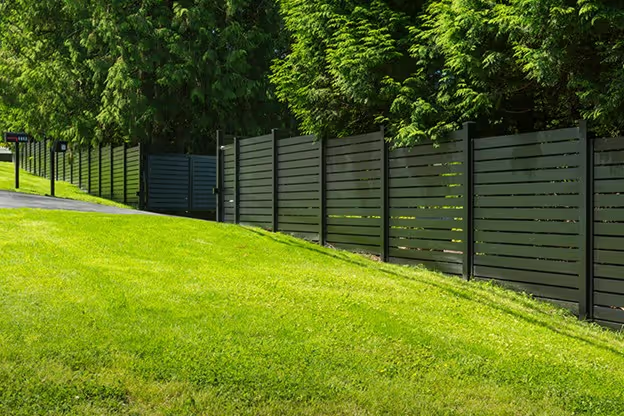
This is where SLEEKFENCE sits on the spectrum. Our system is the world’s first fully engineered, pre-assembled aluminum privacy fence and gate system. The point is not just convenience. The point is controlled tolerances, matched hardware, factory finish quality, and fewer variables for the installer to solve on site.
What “Built-on-Site” Actually Means
A built-on-site fence is assembled in the field from individual components. Depending on the material and system, that may include posts, rails, channels, slats, boards, brackets, spacers, fasteners, and gate frames.
The typical process is straightforward: posts are installed, rails or channels are mounted, boards or slats are placed, fasteners are added, then gates and hardware are fitted. On wood fences, this is the normal method. On many aluminum or architectural fence systems, it is also still common.
There are legitimate reasons to build on site. Highly irregular substrates, custom curves, repair work, very small replacement scopes, and unusual existing conditions may require field-built solutions. There is also real craftsmanship in certain site-built work, especially where a project is truly custom.
The issue is not that site-built fencing has no place. The issue is that it relies heavily on the installer to recreate the intended system under jobsite conditions.
Where Pre-Assembled Wins
Pre-assembled systems win when speed, consistency, engineering, and margin matter.
For contractors, the biggest advantage is that the most time-consuming part of the fence has already been done. Instead of handling every slat, rail, channel, and fastener on site, the crew is setting posts and mounting completed panels. That can reduce jobsite handling, shorten install time, and lower the chance of damage or cleanup. This is particularly valuable with configurations such as Lineara Full Privacy fencing, where numerous individual components would otherwise need to be assembled in the field.
This matters even more with high-end aluminum fencing in darker finishes. Fence installers are often working around dirt, dust, concrete, tools, and outdoor site conditions. Every extra touch creates more fingerprints, smudges, or risk of finish damage. The less the installer needs to handle finished slats and components individually, the cleaner the final installation tends to be.
Pre-assembled systems also help with estimating. You are pricing a defined set of components: panels, posts, gates, fasteners, mounting channels, and accessories. That is much easier than estimating every small part separately, especially on larger commercial projects.
For architects, the advantage is predictability. Pre-made fence panels and gates are easier to specify because they behave more like a defined product system than a collection of loose parts. The designer can use fixed panel modules in Revit or AutoCAD, adjust section lengths where needed, and avoid building a 3D model from every slat, channel, rail, spacer, and fastener.
Where Built-on-Site Wins
Built-on-site work still has value where the job is extremely custom.
If the fence needs to follow an unusual curve, tie into old structures, patch a damaged area, or work around a substrate that is too irregular for a clean modular layout, field-built work may be the better choice. The same can be true for small repair scopes where replacing a few parts does not justify a full system approach.
Site-built work can also be useful when the project is more about custom fabrication than repeatable installation. If the fence is being designed as a one-off sculpture, or the geometry is too unusual for standard components, the flexibility of building in the field has a place.
The key is to be honest about the tradeoff. Site-built gives maximum flexibility, but it also pushes more quality control onto the installer.
Modular Fence Panels and the Jobsite Math
Modular fence panels change the jobsite math because they reduce the amount of work that needs to happen under imperfect conditions.
On a built-on-site system, the installer is responsible for too many variables. Are the slats fastened correctly? Are the right fasteners used? Is the spacing consistent? Were the manufacturer’s instructions followed closely enough to protect the engineering? Did the crew rush certain sections because the schedule was tight?
Those details matter. On some systems, slats are not fastened at all and are simply friction-fit into channels or post slots. That might look fine at first, but it raises a serious engineering question. If the wind rating assumes a certain connection method, but the actual jobsite assembly does not replicate that method, the rating becomes difficult to rely on.
With a pre-assembled system, the manufacturer controls the most important parts of the panel. Slat fastening, fastener type, fastener quantity, alignment, and panel structure are all handled before the product arrives. That reduces the chance that a field decision undermines the system.
There is also practical labor savings. Our mounting channel system allows about half an inch of play at the post connection, so posts do not need to be set with unrealistic perfection. The installer still needs to do good work, but the system gives enough tolerance to make the installation efficient.
For contractors and estimators, this affects margin. Fewer loose parts, fewer truck rolls, fewer corrections, faster close-out, and lower callback risk all matter. That does not mean every project will install at the same rate, and we would not publish a specific labor multiplier without verified project data. But directionally, factory assembly reduces the amount of field labor exposed to jobsite conditions.
Engineering and Quality Control: Factory vs. Field
For architects and specifiers, the biggest question is not just how fast the fence installs. It is whether the installed system reflects what was specified.
Factory assembly gives the manufacturer more control. Alloy selection, panel dimensions, fastener placement, fastener torque, coating quality, dimensional tolerances, and hardware matching can all be managed before the product is released. That matters on projects where the fence is tied to wind load, appearance, or long-term performance. These are also important factors when evaluating aluminum fence manufacturers, particularly for projects that require documented performance and consistent quality.
Aluminum is particularly well suited to factory-controlled, pre-assembled systems because architectural 6xxx-series aluminum alloys are widely used for extrusions and structural profiles. 6063-T6 aluminum is commonly used in architectural applications because it balances extrusion quality, corrosion resistance, and finish appearance. But the alloy alone is not the point. The full system matters.
A pre-assembled aluminum system can be easier to defend in a submittal because there is less uncertainty about how the components are intended to work together. The panel is not being interpreted in the field. It is being installed as a finished assembly. For architects evaluating complete fence and gate systems, SLEEKFENCE architectural products provide specifications, drawings, and supporting technical documentation for project planning and specification.
Coating quality also belongs in this conversation. A high-end powder-coated fence should be specified with the proper coating standard for the environment, and the active AAMA or FGIA coating requirement should be confirmed at the time of specification. On a factory-controlled system, coating thickness, pretreatment, cure, and finish quality can be managed more consistently than when parts are heavily handled during field assembly.
When to Choose Pre-Assembled and When Not To
Choose pre-assembled when the project needs speed, repeatability, clean finish quality, predictable installation, multiple gates, or documented engineering. It is also the better direction when the fence is visible, high-end, commercial, or part of the architecture rather than just a boundary.
It is especially useful on large projects where different crews may be involved over time. A pre-assembled system makes it much harder for Installer A and Installer B to produce noticeably different results.
Stay with built-on-site when the geometry is highly custom, the repair scope is small, or the fence needs to integrate with existing conditions in a way that cannot be handled cleanly with standard components. Built-on-site work still has a place. It just needs to be chosen for the right reasons.
The decision should come down to risk. If the main risk is that the system needs to be highly custom, field-built may be appropriate. If the main risk is installation inconsistency, schedule, finish quality, or engineering reliability, pre-assembled is usually the better choice.
FREQUENTLY ASKED QUESTIONS
Are pre-assembled fence panels stronger than built-on-site fences?
They can be, but it depends on the system. Pre-assembled fence panels are not automatically stronger just because they arrive assembled. The advantage is that the manufacturer can control the critical connections, fasteners, spacing, and panel structure. That makes it easier to maintain the engineering intent compared with systems built piece by piece in the field.
How much faster are modular fence panels to install?
It depends on the project, site conditions, crew, mounting method, and gate count. In general, modular fence panels reduce the amount of field assembly required, which usually shortens installation time. Specific labor savings should be based on verified project data, not generic multipliers.
Can pre-assembled panels handle slopes and irregular grade?
Yes, if the system is designed for it. A good modular fence system can be stepped, adjusted, cut, or configured to handle slope without making the finished result look forced. The key is whether the manufacturer has designed the panel and post system to accommodate those conditions.
Do pre-assembled fences look as custom as site-built ones?
They can look just as custom when the system has the right design flexibility. On most commercial and high-end projects, the goal is not random customization. The goal is clean, consistent execution. Pre-built fence panels can still be resized, adjusted, stacked, and configured, but they keep the finished result more controlled.
Why pre-assembled fence panels are typically selected
The simple way to look at it is this: factory assembly compresses risk, while site building offers maximum custom geometry.
Both approaches have a place. But on projects where finish quality, installation speed, engineering, and consistency matter, pre-assembled fence panels provide a clear advantage. They reduce jobsite variables, make estimating easier, simplify specification, and help protect the final result from avoidable field mistakes.
That is why engineered, pre-assembled aluminum fencing is becoming the better fit for commercial projects, architect-led work, and high-end properties where the fence needs to perform and look right.
If you are planning a project and want to compare a built-on-site approach against a pre-assembled aluminum system, our team can review the layout, site conditions, gates, and engineering requirements early in the process.
References
Related Posts

Let’s Discuss Your Project
From early planning through installation, our team provides clear technical guidance and coordinated project support.