Should You Leave a Gap between Modern Fence Panels?
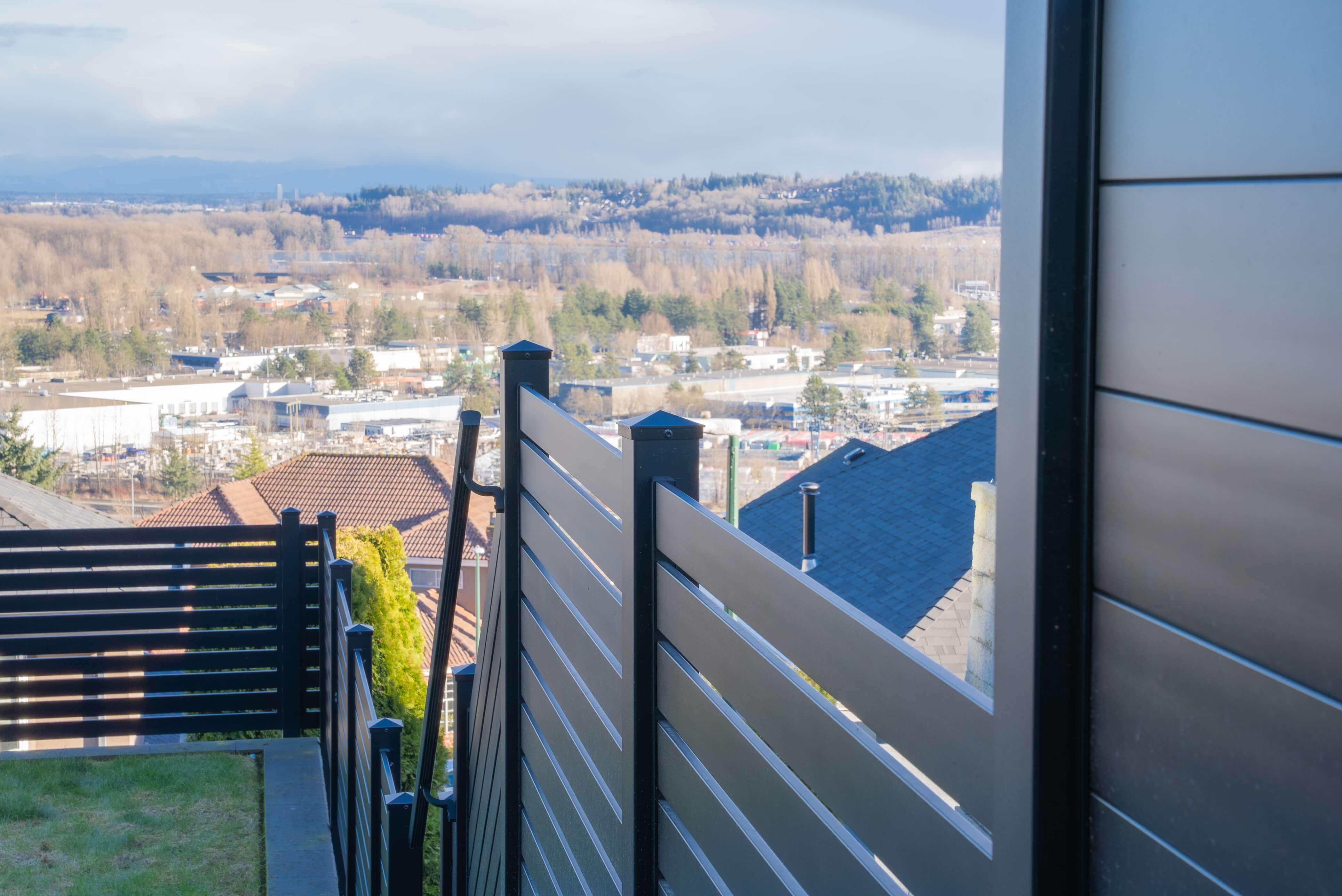
Some things you don’t think about until you’re already halfway through the job, like whether your modern fence panels need a gap between them. It does seem like a minor point, but it can make a big difference to the results you get for your project.
Professional installers factor in thermal expansion, since aluminum fences can grow by roughly 1/4″ over just 10 ft. This means that deliberate spacing prevents buckling, tension points, or misalignment.
If you leave too much space, you lose privacy. Not enough, and you might end up with buckled panels or awkward tension points. So, what’s the right move? That depends on your materials, your layout, and what kind of result you’re after.
What’s the Point of Leaving a Gap Between Modern Fence Panels Anyway?
With traditional wooden fencing, gaps help with air flow, heat expansion, and avoiding moisture traps. But with modern fence panels made from materials like aluminum or composite, you don’t have the same swelling or shrinking.
This means you do not have to leave a gap for performance reasons, especially with prefabricated panel systems. That said, some people still choose to include a small visual break between panels, usually for one of three reasons:
- To follow a slope (with a step-down effect)
- To allow light through, depending on the style
- To give each panel its own defined boundary
But in most modern designs, especially if you’re going for privacy, those gaps are kept tight or hidden entirely. The clean, uninterrupted look is part of what gives aluminum fence panels their appeal and why it is desirable for your commercial project.
When a Gap Makes Sense…
There are still times when a small gap is appropriate. If you’re installing panels on uneven ground, for example, leaving space between them can help each panel sit naturally without twisting the frame or leaning. It gives you just enough room to adjust for level and plumb without forcing anything. This can be determined on site by a SLEEKFENCE trained and approved contractor.
You might also leave a bit of breathing room if you’re using a mounting bracket or post slot system that flexes slightly. Even a ⅛-inch buffer can make a tight install go smoother.
And of course, there’s the purely aesthetic route. Some people like the pattern of evenly spaced vertical panels with narrow gaps, especially if they’re aiming for a more architectural or minimalist effect.
When No Gap is Better…
If privacy is your priority, tighter is better. Most privacy-focused panel systems are designed to overlap or interlock, leaving no visible space between them. This keeps sightlines blocked and creates a cleaner, more uniform look.
It also reduces the chance of wind whistling through or debris slipping between panels, which is another reason to skip the gap if you’re going for full coverage.
At SLEEKFENCE, for example, our flat panels are built to fit snugly with matching posts and trim, so you don’t need to fuss with manual spacing. You get a sharp, even finish without the guesswork.
Setting up Your Modern Fence Panels Your Way
For commercial architectural applications, the question often extends beyond spacing alone—it’s about whether the specified panel system aligns with the performance and design intent of the project. If light transmission is a priority, incorporating a slatted configuration may be more appropriate than a fully opaque privacy panel.
Our aluminum panel systems are engineered to support a range of design outcomes, offering flexibility in both form and function. To learn more, visit our website or contact our team to discuss your project requirements. Our experienced specialists are available to provide guidance from specification through installation.
Related Posts



Let’s Discuss Your Project
From early planning through installation, our team provides clear technical guidance and coordinated project support.