Choosing a Fence for Windy Areas: What Actually Holds Up
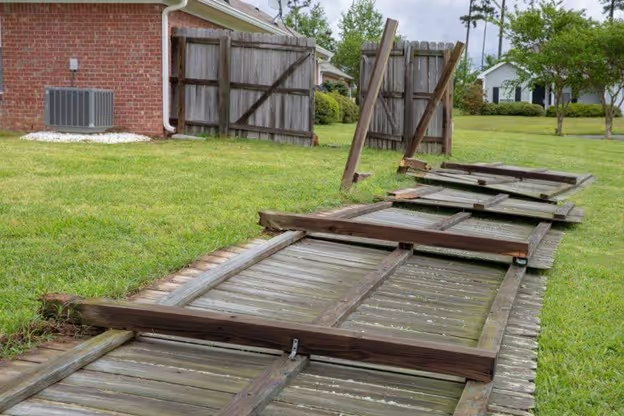
Wind is not a one-time event, it’s a constant, cumulative force. Most fence failures don’t happen overnight. They show up gradually as loosening posts, racking panels, and connections that slowly give out. In almost every case, the issue isn’t a single weak component, a system that was never designed to manage wind as a whole.
A common mistake is treating a fence as a static object. In reality, it is always under movement. Solid panels catch pressure, posts take on leverage, and fasteners absorb repeated micro-movement. Over time, those forces build. Fully solid designs, especially across longer spans, can act like sails. Without the right structural approach, that pressure works its way into every connection point.
How Wind Actually Acts on a Fence
When wind hits a fence, it creates both pressure and suction. One side is pushed while the other is pulled, and that push-pull effect is what drives stress into posts, panels, and fasteners.
Allowing some controlled airflow—without fully sacrificing privacy—can significantly reduce peak loads. This isn’t about making a fence open; it’s about avoiding total resistance. Systems that are designed to manage airflow tend to perform more predictably than those that simply try to block everything.
Height adds another layer. As fences move from 6 ft to 8 ft and beyond, the force doesn’t just increase—it amplifies. More leverage is applied at the base and at every connection point. A system that performs well at lower heights can behave very differently when scaled up if it hasn’t been engineered for it.
Why Material and Structure Matter Over Time
Material choice plays a major role, especially long-term.
Wood moves with moisture and temperature, which introduces ongoing stress into connections. Steel can be strong initially, but becomes vulnerable as coatings wear and corrosion begins. What matters is not just strength on day one, but consistency over time.
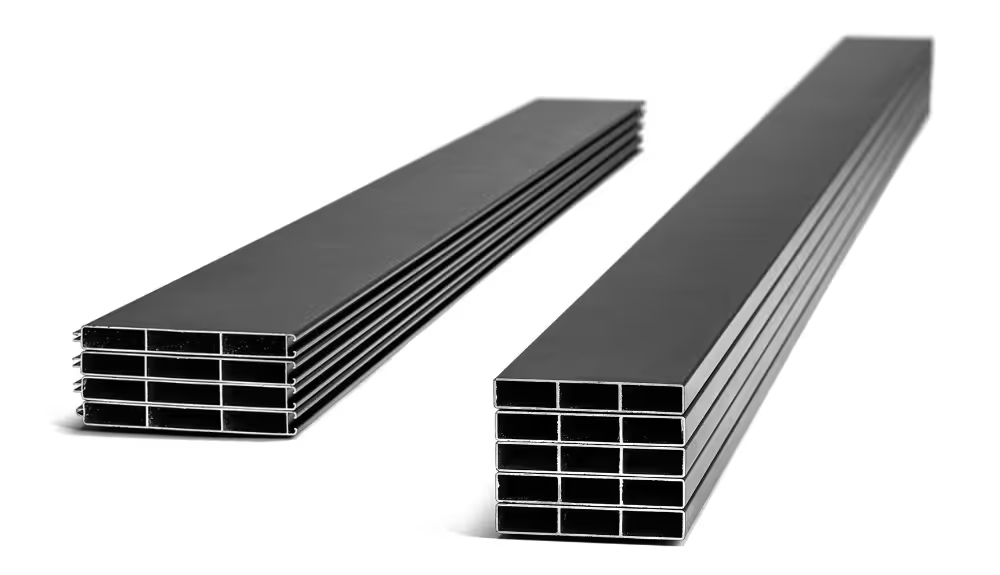
Extruded aluminum behaves differently. It maintains its shape, resists environmental movement, and allows structural geometry to be built directly into the profile. Internal ribbing and wall thickness can be engineered to limit deflection and keep panels aligned under load.
Just as important is how everything is connected. Wind is repetitive. Systems that rely on clips or friction-fit components tend to loosen over time. Mechanically fastened assemblies maintain their position because each connection is fixed, not just held in place.
A System Approach vs. Individual Components
Wind performance is never about a single feature. It’s the result of how the entire system works together.
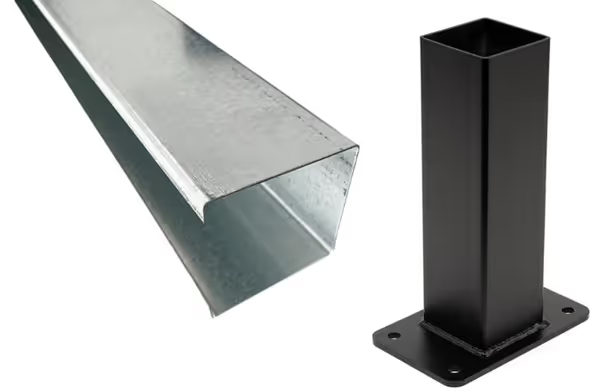
Posts, panels, fasteners, and mounting methods all contribute to how load is distributed. Reinforcement—such as internal steel within posts—can significantly increase performance, particularly for taller fences or exposed environments. Anchoring methods, whether in-grade or surface-mounted, also play a critical role depending on site conditions.
Our steel post inserts (left) and concrete mount bases (right) strengthen the aluminum posts to give extra protection from heavy winds.
Local factors still matter. Wind exposure, soil conditions, orientation, and regional building requirements all influence performance. A fence that works in a sheltered backyard will not perform the same way in an open coastal or high-wind environment.
For projects that require a clearer starting point, we’ve put together a reference chart outlining typical applications, wind ratings, and system configurations.
This is not a substitute for engineering, but it helps frame what level of system is typically required based on height, exposure, and application.
Proven Performance in High-Wind Conditions
In real-world applications, these design principles are what separate systems that hold up from those that fail.
Projects installed in hurricane-prone regions have demonstrated that when a fence is properly engineered—with rigid materials, mechanical fastening, and appropriate reinforcement—it can withstand extreme conditions without panel loss or structural failure. This includes installations that have remained intact through major storm events, reinforcing the importance of a complete system approach rather than relying on individual components.
Short clip showing real-world performance under extreme conditions
Why This Type of System Is Typically Selected
On commercial and architect-led projects, wind resistance is not treated as an upgrade—it’s a baseline requirement.
Fencing systems that perform in these environments tend to share a few characteristics:
- They are designed as a complete, engineered system
- They use rigid, stable materials that maintain alignment over time
- They rely on mechanical fastening rather than friction-based assembly
- They can be adapted to height, exposure, and site-specific requirements
A modular aluminum system built around these principles doesn’t just resist wind—it manages it. Load is distributed, movement is controlled, and long-term performance is built into the design from the outset.
For projects where durability, safety, and long-term appearance matter, this approach becomes the standard - not the exception.
If you’re planning a project and want to make sure the fence system is aligned with your site conditions, layout, and engineering requirements, contact us so our team can help review your plans and provide guidance early in the process.
Related Posts


Let’s Discuss Your Project
From early planning through installation, our team provides clear technical guidance and coordinated project support.