Will Your Horizontal Privacy Fence Sag?
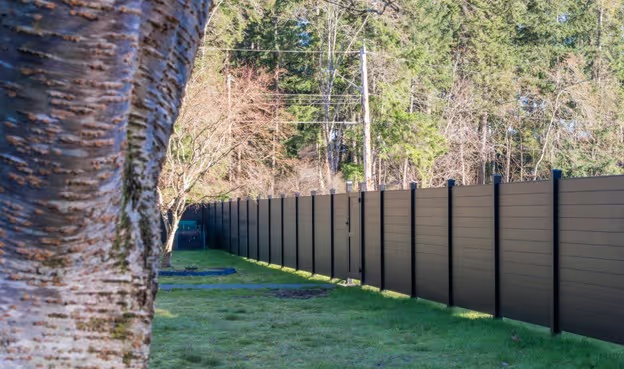
If you’re asking whether a horizontal fence will sag, the real answer is: it depends on how it’s built. The horizontal look isn’t the problem—it’s the structure behind it.
Gravity is always working against a horizontal layout. Over longer spans, especially with wood or lighter vinyl systems, that pressure starts to show. Boards can crown, fasteners loosen, and what began as a clean, modern line gradually loses its edge. That’s where most of the skepticism around horizontal fencing comes from—it’s not unfounded.
Where a modular aluminum system like SLEEKFENCE changes things is in how it’s engineered from the start.
Instead of relying on flat boards spanning post to post, each panel is formed from rigid aluminum extrusions with internal ribbing. That geometry does a lot of the heavy lifting. You’re not asking the material to behave—you’re designing it so it doesn’t have a choice. It resists deflection by shape, not just thickness.
Each connection is also doing real work. Boards don’t just sit in place—they interlock, nest, and are mechanically fastened at every joint. That creates a continuous structure across the panel, distributing load instead of concentrating it in a few weak points. It’s a different level of consistency compared to systems that rely on friction fit or loose channel capture.
Post spacing plays a bigger role than most people expect. Keeping spans to six feet on center limits the opportunity for flex and keeps the system square over time. Once you start stretching beyond that—eight feet or more—you’re introducing leverage that most horizontal systems simply aren’t designed to handle long-term.
To simplify it, here’s where the rigidity comes from:
- Extruded aluminum profiles with internal ribs for structural strength
- Mechanical fastening at every board joint, not just end retention
- Nested, tight-tolerance fitment to eliminate play within the panel
- Six-foot post spacing to reduce span-related deflection
- Consistent material behavior that doesn’t expand, warp, or soften like wood or vinyl
Material stability is the other half of the equation. Wood moves—it absorbs moisture, dries out, and shifts with the seasons. Vinyl can soften under heat and has a natural tendency to flex. Aluminum, especially in an extruded form, stays dimensionally consistent. That allows for tighter tolerances and cleaner lines that actually hold.
For designers, that means the intent stays intact. Shadow lines remain crisp, horizontals stay true, and the visual rhythm doesn’t drift over time. For contractors, it removes a lot of the on-site guesswork—what you install is what it stays. And for builders or homeowners, the modular, plug-and-play nature makes the system predictable without sacrificing performance.
That said, not every project needs to be horizontal aluminum. But if the concern is sag, flex, or long-term alignment in a horizontal system, the structure—extrusion profile, fastening method, and span—will always matter more than the style itself.
If you’re planning a project and want to make sure the fence system is aligned with your site conditions, layout, and engineering requirements, contact us so our team can help review your plans and provide guidance early in the process.
Related Posts



Let’s Discuss Your Project
From early planning through installation, our team provides clear technical guidance and coordinated project support.