Aluminum Fence Post Installation for Commercial Projects: What Actually Matters
When people look up aluminum fence post installation, most of what comes up is geared toward light-duty or residential work. Driving posts, quick installs, shortcuts.
That approach does not apply to high-end aluminum fencing.
On commercial and architect-led projects, post installation is not a preference—it’s what determines whether the fence performs properly over time. Wind load, mounting conditions, and site constraints all need to be considered up front.
At a high level, driving posts into the ground is not a viable option. It doesn’t provide the consistency or structural integrity required for a system that’s expected to last.
Why the Post Base Is What Everything Depends On
In most aluminum fence systems, the panels aren’t the issue. The weak point—if there is one—is always at the base of the post.
That’s where all the load transfers. Wind pressure, gate movement, and long-term stress all come back to that one point where the post meets the ground or mounting surface.
If that condition isn’t right, the fence will eventually move. It might take time, but it will happen.
That’s why post installation needs to be treated as part of the system design, not something figured out in the field.
Installation Methods Depend on the Project
There isn’t one correct way to install aluminum fence posts. It depends entirely on the site.
For standard ground-mounted applications, posts are set into concrete footings. This is the most common approach and, when done properly, gives reliable long-term performance. The size and depth of those footings depend on soil conditions, fence height, and wind exposure.
Once you move into taller fences or higher wind zones, additional reinforcement is often required. This typically means a steel insert embedded into the concrete footing, with the aluminum post sleeved over it. That’s how you meet structural requirements without changing the finished look.
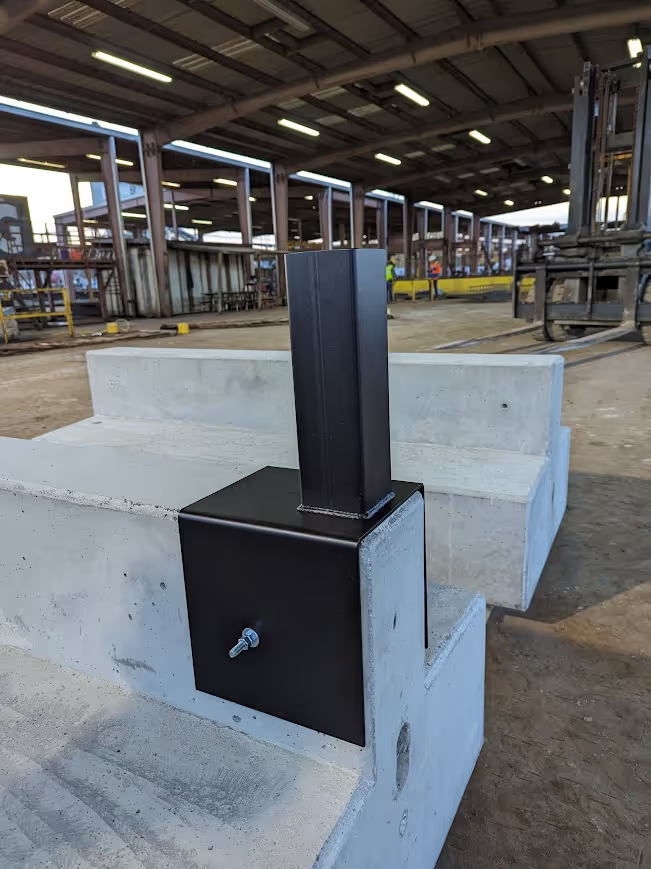
For surface-mounted applications—like retaining walls, slabs, or rooftop conditions—you’re dealing with a different set of constraints. Posts are mounted using engineered plates or bracket systems, and those need to be designed for the loads involved. Rooftop work adds another layer with waterproofing and membrane protection.
In bedrock conditions, you can’t use traditional footings at all. The typical approach is to core drill into the rock and install a custom steel bracket with a rebar leg epoxied into place. The aluminum post then sleeves over that support. Done properly, it’s a very solid solution.
The advantage with aluminum is that the posts are hollow, so they can sleeve over a wide range of internal supports. That flexibility is what allows the system to work across very different site conditions.
Post Size and Gates Are Where Mistakes Happen
One of the most common issues is treating all posts the same.
For standard fence runs, smaller posts, like 3", can work fine. But they should not be used for gates.
Gate posts carry more load, more movement, and more stress over time. At a minimum, you should be stepping up to 4" posts, and in most commercial applications, those posts need internal reinforcement.
When you see gates sagging, misaligned, or failing early, it almost always comes back to the post.
This is not the place to cut corners.
Site Conditions Should Drive the Decision
Every project has its own constraints, and the installation method needs to follow that.
Wind exposure, soil stability, fence height, and existing site conditions all play a role. Coastal or open sites require more robust solutions than sheltered areas. Taller fences increase load. Existing retaining walls or foundations can limit what’s possible.
On new construction, these factors are usually addressed in the design phase. On replacement projects, they need to be evaluated properly before installation starts.
A good contractor will account for this. A good manufacturer will help guide it.
Why Manufacturer Input Matters
One of the biggest gaps in projects is the disconnect between the product and how it’s installed.
A quality aluminum fence manufacturer should be involved early to confirm post sizing, mounting methods, and any required reinforcement. This removes guesswork and ensures the system is installed the way it was designed to perform.
It also helps avoid small decisions on site that turn into bigger problems later.
Why This Matters
Aluminum fencing is usually chosen because it’s a long-term solution. It holds its appearance, doesn’t rust, and doesn’t require ongoing maintenance.
But none of that matters if the post installation isn’t done properly.
Most fence failures don’t come from the material—they come from how the system was installed at the base.
If the posts are right, the system performs. If they’re not, you’ll see it over time.
Why Aluminum Fence Post Installation Needs to Be Done Properly
Driving posts might be acceptable for temporary or low-grade fencing, but it doesn’t belong in high-end aluminum systems.
On commercial and architect-led projects, installation needs to match the level of the design. It needs to account for loads, conditions, and long-term performance.
That’s what ensures the fence not only looks right when it’s installed but continues to perform the way it should years down the line.
If you’re pricing or planning an installation and want to avoid surprises on-site, we can walk through the system, layout, and requirements to make sure everything is clear before the project starts.
Related Posts



Let’s Discuss Your Project
From early planning through installation, our team provides clear technical guidance and coordinated project support.