Data center perimeter security encompasses fencing, gates, visual screening, setbacks, and other site measures that support controlled access and define a facility’s boundaries. As communities place greater scrutiny on data center development, perimeter design has become an increasingly important part of zoning approvals, neighborhood compatibility, and architectural planning.
Key Takeaways
- Security and appearance: Data center perimeters must address controlled access while considering how facilities are viewed from surrounding properties.
- Growing community opposition: According to Data Center Watch, at least 75 U.S. data center projects representing approximately $130 billion were blocked or delayed during Q1 2026.
- Local development requirements: Ordinances may establish separate rules for building setbacks, landscape buffers, visual screening requirements, and permissible fencing materials.
- Limits of perimeter design: Fencing and screening can address visibility and certain site-layout concerns, but cannot independently resolve electricity demand, water consumption, or equipment noise.
What Is Data Center Perimeter Security?
Data center perimeter security involves coordinating physical boundaries, access points, and monitoring measures around a facility. Its primary function is to support site protection and controlled access, while screening and landscape design also influence how the development relates to surrounding properties.
The perimeter may incorporate fences, pedestrian and vehicular gates, visual screening, landscape buffers, surveillance, and intrusion detection. Each element serves a different purpose, and selection depends on the facility’s security strategy, operational requirements, and applicable local regulations.
Fence height, panel configuration, and access points should be considered together. Where climb resistance is relevant, smooth fence panels without accessible handholds or footholds can help discourage climbing, making them an important consideration in anti-climb fence design.
Why Are Communities Pushing Back on Data Centers?
Community opposition to data centers is driven by concerns about electricity demand, water consumption, noise, infrastructure costs, and changes to surrounding neighborhoods. These concerns increasingly influence site selection, zoning decisions, and project approvals.
According to Data Center Watch’s Q1 2026 report, at least 75 U.S. data center projects representing approximately $130 billion in proposed investment were blocked or delayed between January and March 2026. The report says this roughly matched the scale of projects affected during all of 2025.
The same report counts 833 active opposition groups across 49 states by the end of Q1 2026, up from 396 at the end of 2025, and more than 300 state-level data center bills introduced in the first six weeks of 2026. These figures describe projects blocked or delayed, not necessarily permanently canceled.
Community concerns do not necessarily mean opposition to development itself. Proposed facilities may bring investment, employment, and tax revenue, while raising questions about infrastructure capacity and neighborhood impacts. Addressing these considerations early can inform site planning and community engagement.
What Do Neighbors Object To?
Residents’ concerns range from visual appearance and noise to electricity demand, water consumption, and infrastructure costs. Perimeter design can help address some site-specific concerns, but others require separate technical, operational, or policy solutions.
Landscaping can complement architectural screening, but deciduous vegetation may provide less visual coverage during winter months. Continuous privacy fencing can maintain year-round screening, subject to the site’s design and zoning requirements. It cannot substitute for measures addressing energy consumption, water use, or equipment-generated noise.
What Do Data Center Ordinances Require for Fencing and Screening?
Data center ordinances may establish requirements for building setbacks, equipment placement, landscape buffers, visual screening, and fencing materials. The requirements vary by jurisdiction, and meeting a setback does not automatically satisfy screening or security rules.
Setbacks and landscape buffers
As one example of data center setback requirements, in September 2024, Fairfax County, Virginia, approved an amendment requiring data center buildings to be at least 200 ft from the lot line of an adjacent or abutting residential district or property. Equipment such as backup generators must be 300 ft from residential property lines or separated by the data center building; lesser distances may be allowed by special exception. The county’s official announcement also describes equipment-screening, building-design, and noise-study requirements.
Franklin County, Indiana, adopted a data center zoning ordinance on September 30, 2026. Local reporting on the adopted ordinance describes generally 300 ft setbacks, a 100 ft landscaped buffer, and reduced setbacks along certain industrial boundaries.
Visual screening requirements
Screening rules may address whether generators, electrical equipment, service areas, or buildings remain visible from neighboring properties or public roads. Fairfax County, for example, requires covered equipment to be enclosed or screened by a wall or similar barrier. Where complete opacity is required, fence height alone is insufficient: panel openings and viewing angles matter. This is why perimeter screening must be evaluated from the surrounding properties, not merely from inside the site.
Fence placement and permitted materials
Local data center screening requirements may regulate security fencing relative to public roads and landscape buffers. This may require outward-facing architectural or landscape screening with a separate security boundary farther inside the site. A fence that meets a site’s security requirements may not necessarily meet local regulations for visual screening, materials, or appearance.
What Data Center Fencing Meets Visual Screening Requirements?
The appropriate data center fencing depends on whether a facility requires complete visual screening, partial privacy, or a defined security boundary. Local rules may specify opacity, height, acceptable materials, and placement, while the facility’s security strategy determines additional measures.
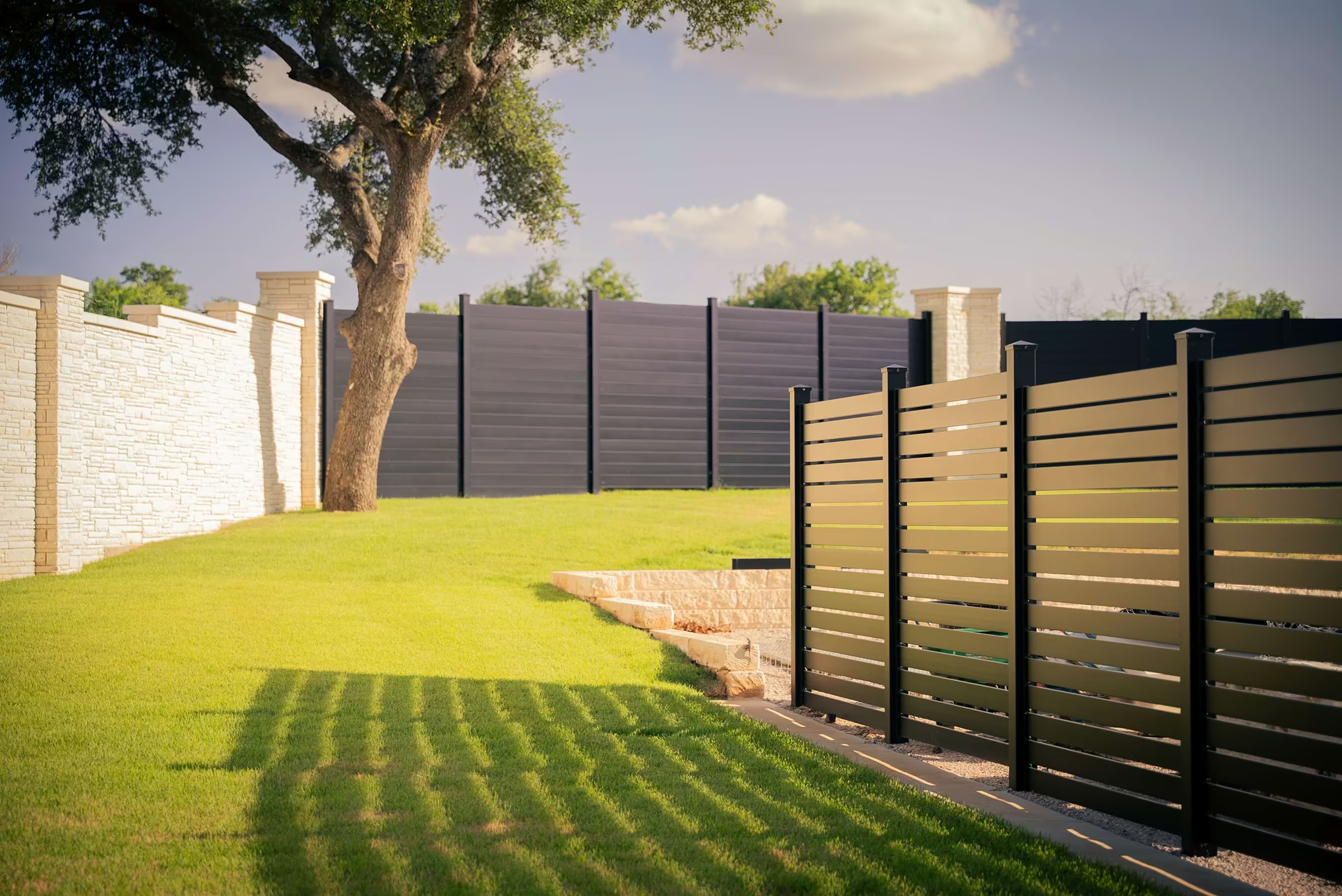
For projects requiring complete visual screening, Lineara Full Privacy combines continuous horizontal aluminum profiles with clean architectural lines and no visibility through the panel face. Where partial screening and airflow are appropriate, Lineara Semi Privacy provides approximately 85% privacy while maintaining a cohesive, contemporary appearance.
Both configurations are available in engineered heights up to 12 ft, with structural performance dependent on the specified system configuration, mounting approach, and site conditions. Taller, more opaque fencing also requires appropriate consideration of wind loading. Available wind ratings and supporting documentation should be reviewed during specification.
A data center security fence should account for controlled pedestrian and vehicular access, maintenance, and coordination with surveillance systems. Broader data center fencing applications show how privacy levels, fence heights, and gate configurations can be considered together.
Visual screening and security performance are not interchangeable. Architectural aluminum is one option for critical infrastructure fencing, but visual screening alone does not establish specialized intrusion-delay or vehicle-impact resistance.
Can Fencing Reduce Data Center Noise?
Fencing can help reduce certain types of noise when specifically designed and tested for acoustic performance. Standard privacy fencing should not be assumed to provide meaningful noise reduction simply because it forms a solid visual barrier.
Data center noise can originate from backup generators, cooling equipment, ventilation systems, and other infrastructure. A purpose-designed acoustic barrier may interrupt certain direct sound paths, but rooftop equipment can transmit sound over a perimeter fence. Low-frequency sound may require separate mitigation.
Noise management can involve equipment enclosures, acoustic barriers, equipment placement, and setbacks, evaluated through project-specific acoustic analysis. For applications where sound performance is specified, available sound ratings and technical documentation should be reviewed rather than assuming visual screening provides a particular level of outdoor noise reduction.
How Do You Get Data Center Perimeter Design Approved?
Data center perimeter approval begins with understanding local zoning requirements and coordinating security, screening, setbacks, and architectural design early in the planning process. Approval may involve planning departments, zoning authorities, and other reviewing agencies.
- Confirm applicable regulations. Review adopted zoning ordinances, design guidelines, and approval procedures, including data center provisions.
- Identify site requirements. Establish building and equipment setbacks, buffers, screening requirements, permitted materials, and height limits.
- Coordinate security and screening. Determine where one boundary can serve both purposes and where separate landscape or architectural treatments are needed.
- Evaluate operational considerations. Account for access, equipment clearances, maintenance, ventilation, and surveillance coordination.
- Prepare architectural and technical documentation. Provide site plans, fence elevations, specifications, gate details, and supporting performance documents.
- Show views from surrounding properties. Use elevations, site perspectives, and landscape plans to communicate the completed perimeter’s appearance.
Early coordination helps identify conflicts before formal review. Final approval depends on applicable regulations, project-specific requirements, and decisions by the relevant authorities.
Frequently Asked Questions
What kind of fence do data centers use?
Data centers use fencing selected for security, screening, and local regulations. Options include chain link, welded wire mesh, steel, and architectural aluminum systems. Full Privacy aluminum fencing is particularly relevant where complete visual screening and architectural appearance are priorities.
How far does a data center have to be from homes?
There is no nationwide setback distance for data centers. Local ordinances may impose different distances for buildings, generators, and other equipment. Fairfax County, Virginia, has adopted a 200 ft building setback and separate 300 ft requirements for certain equipment near residential properties, subject to specified conditions.
Do data center fences have to be solid?
Not necessarily. Some jurisdictions require opaque screening, while others permit partially open fencing, landscape buffers, or combined treatments. The correct configuration depends on local ordinances and the site’s security and operational needs.
Can a fence block data center noise?
Purpose-designed acoustic barriers may reduce certain sound transmission paths, but standard privacy fencing is not a substitute for acoustic mitigation. Noise from cooling systems and generators may require equipment-specific measures and site-level analysis.
Why do some counties ban chain-link fencing at data centers?
Some jurisdictions restrict chain link on public-facing boundaries because its appearance and limited screening may not meet local design standards. It may remain permissible in other locations or behind an approved screen, depending on the ordinance.
Who decides what a data center perimeter has to look like?
Local zoning ordinances and design standards set requirements. Planning departments, commissions, and other reviewing authorities assess compliance, while architects, engineers, and security teams coordinate the design.
Bringing Security, Screening, and Site Design Together
Data center perimeter security is increasingly connected to site planning, architectural appearance, and community expectations. Addressing fencing, visual screening, setbacks, and access requirements early helps project teams develop coordinated designs that respond to operational needs and local regulations.
SLEEKFENCE’s architect resources include CAD details, CSI specifications, and technical documentation to support evaluation of architectural aluminum fencing systems.
References
Data Center Watch — Q1 2026 Report
Fairfax County — Data Center Zoning Ordinance Amendment, September 2024
The Brookville American — Franklin County ordinance adoption, October 2026